Broad Search Categories
Senior UX Designer | Amazon Search
Customer Problem
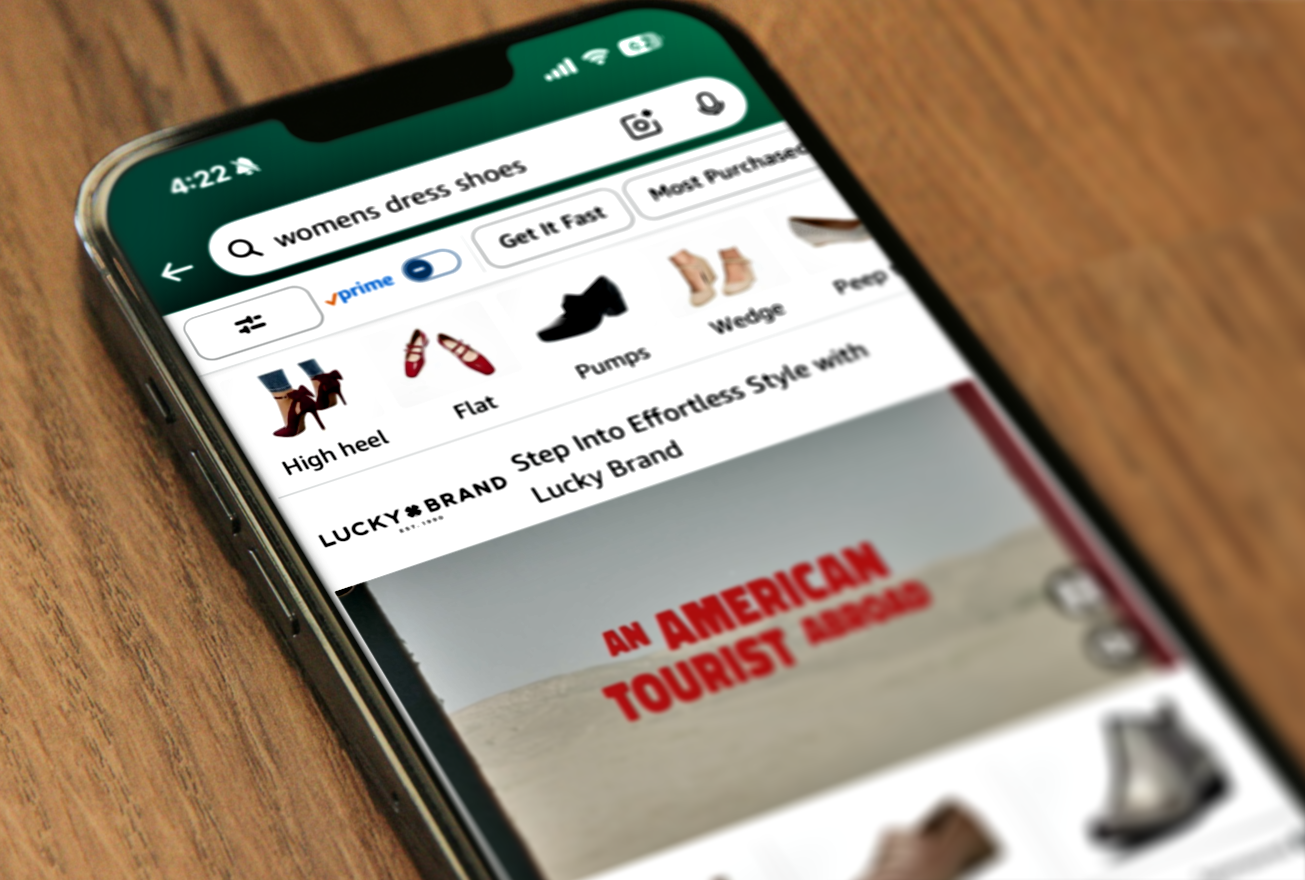
Customers who were unsure what they were looking for often began with broad searches such as “women’s outfits”, which lacked clear intent and resulted in excessive scrolling and lower conversion.
My Role
I led initial ideation and contributed across end-to-end design through delivery, rapidly validating multiple solution paths via internal testing and customer feedback to reduce UX risk. Drove alignment across leadership, product, and engineering through interactive prototypes, clear specs, and a forward-looking style guide that aimed to improve functionality and visual style over the current design.
solution
For customers who begin with broad, open-ended searches such as “women’s outfits”, and are still forming intent, Broad Search Categories appear just below the refinement bar.
These categories reduce cognitive load by providing clear, relevant entry points, helping customers explore, refine, and progress toward faster, more confident discovery.
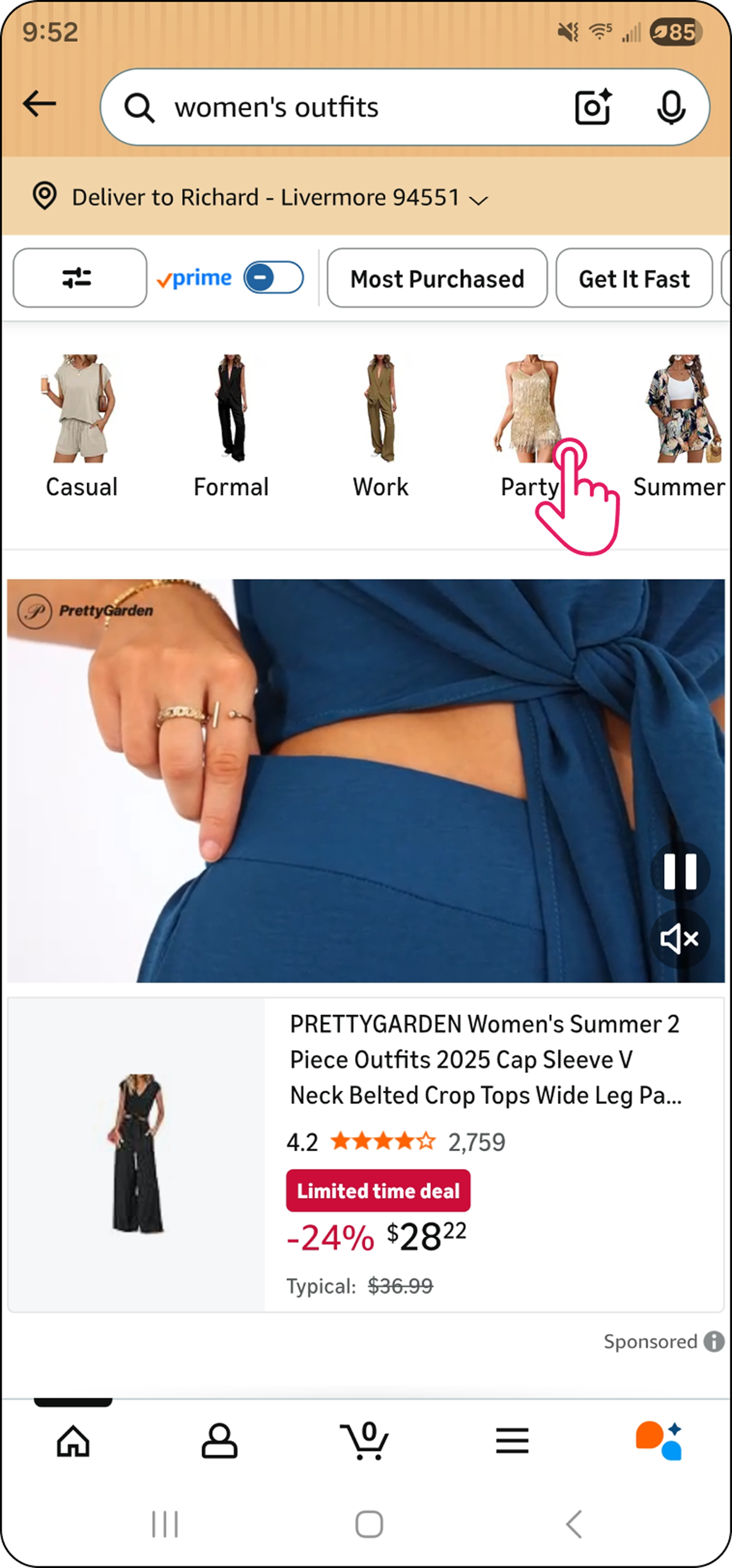
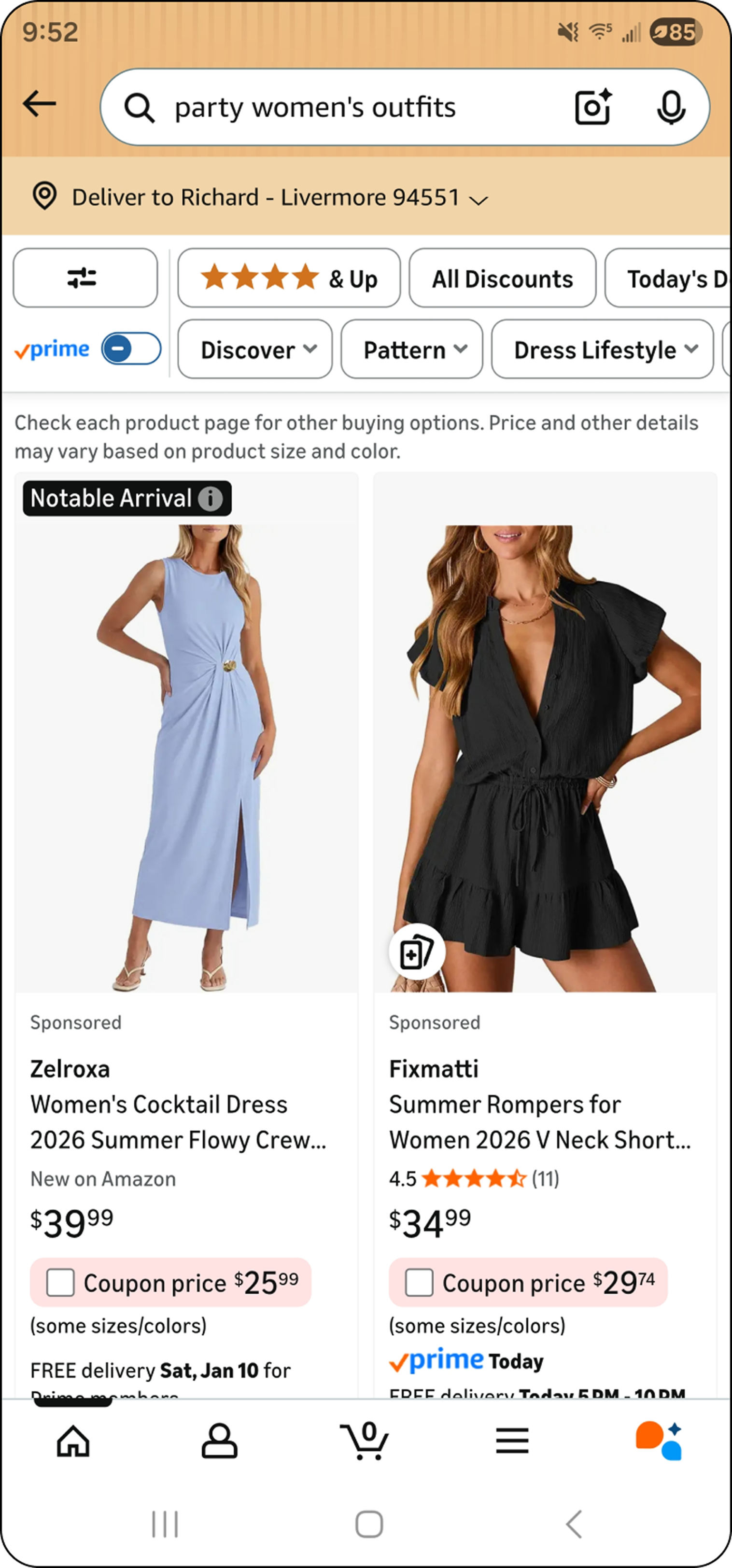
When a customer selects a category such as “Party”, the search results are reformulated to reflect that selection. The refinement bar updates in parallel, preserving context while narrowing the product set.
Launched in July 2025, Broad Search Categories appear at the top of search results, surfacing clear, categorized recommendations that help customers explore, refine, and move more quickly toward relevant products.
Early experiments validated our hypothesis that presenting category breakdowns for broad queries improves customer experience and engagement.
Once the prototype was functional on mobile, I moved quickly to get it in front of customers to gather early qualitative feedback. To do this, I ran an informal intercept study during lunch hours, setting up in a shared kitchen space and recruiting participants as they passed through. In exchange for approximately 10 minutes of their time, participants received small incentives such as stickers or internal phone tool badges.
Each session began with a brief overview of the feature’s capabilities, after which participants were encouraged to explore freely. Following a five-minute hands-on interaction, participants completed a short survey combining single-choice, multiple-choice, Likert-scale, and open-ended questions to capture both usability signals and subjective feedback.
This lightweight intercept approach allowed us to gather fast, in-context feedback from real mobile users without the overhead of formal recruiting. It helped surface early usability issues, validate core interactions, and inform iteration decisions before committing to larger-scale testing.

User Testing
Establishing a reusable design pattern
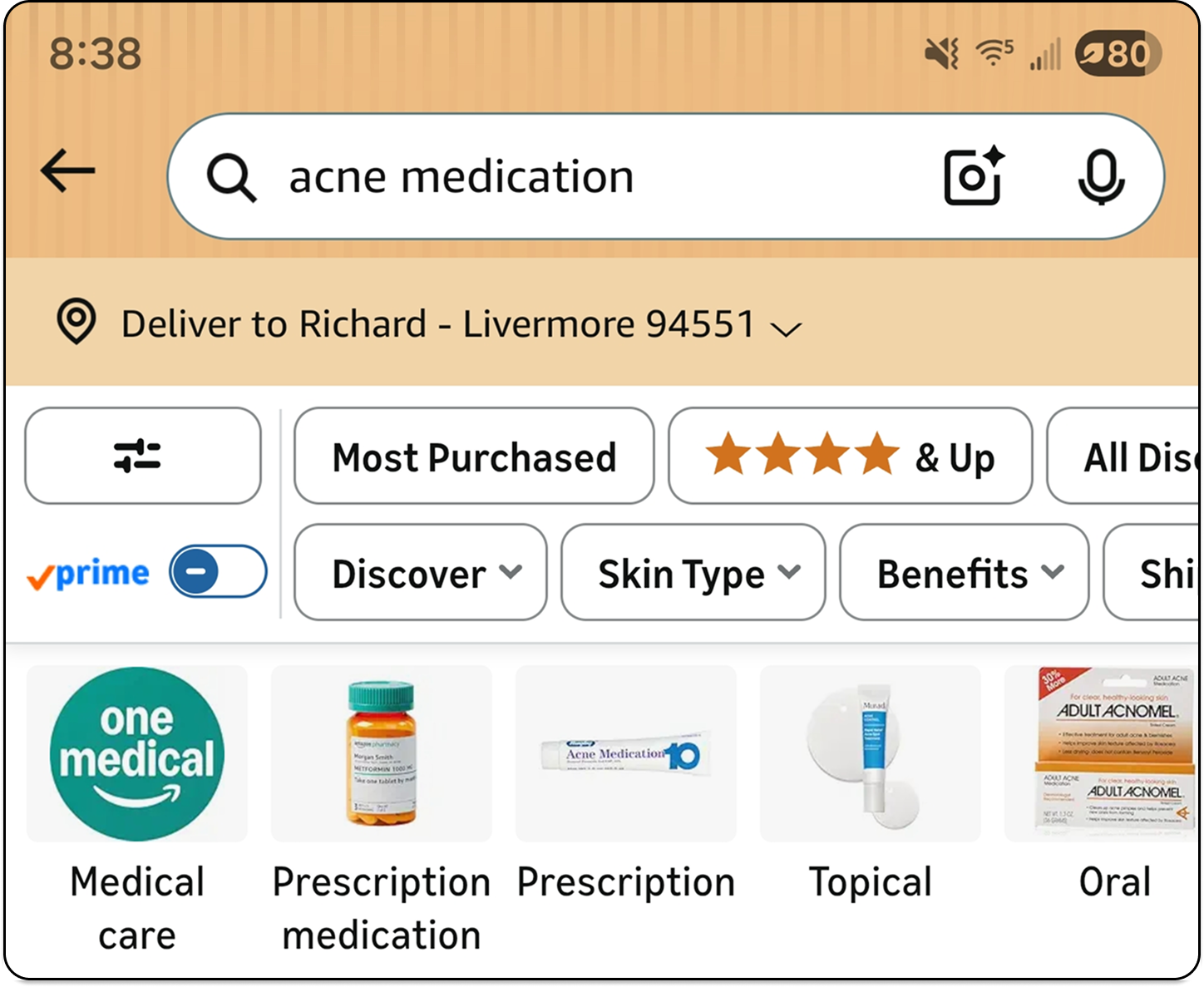
After seeing strong customer adoption, this feature naturally grew into a reusable design pattern that went beyond its original use. Teams across Amazon, including Amazon Health and Amazon Deals, began adopting the system and applying it to their own products and storefronts, adding their own flavor while keeping the same core interactions and visual language. The success of the pattern showed how a customer tested design system can scale across teams, stay flexible, and create consistency without getting in the way of individual product needs.
Amazon Health
Amazon Health uses categories such as “Medical care” to surface the One Medical storefront and “Prescription medication” to surface relevant prescriptions.
Amazon Deals
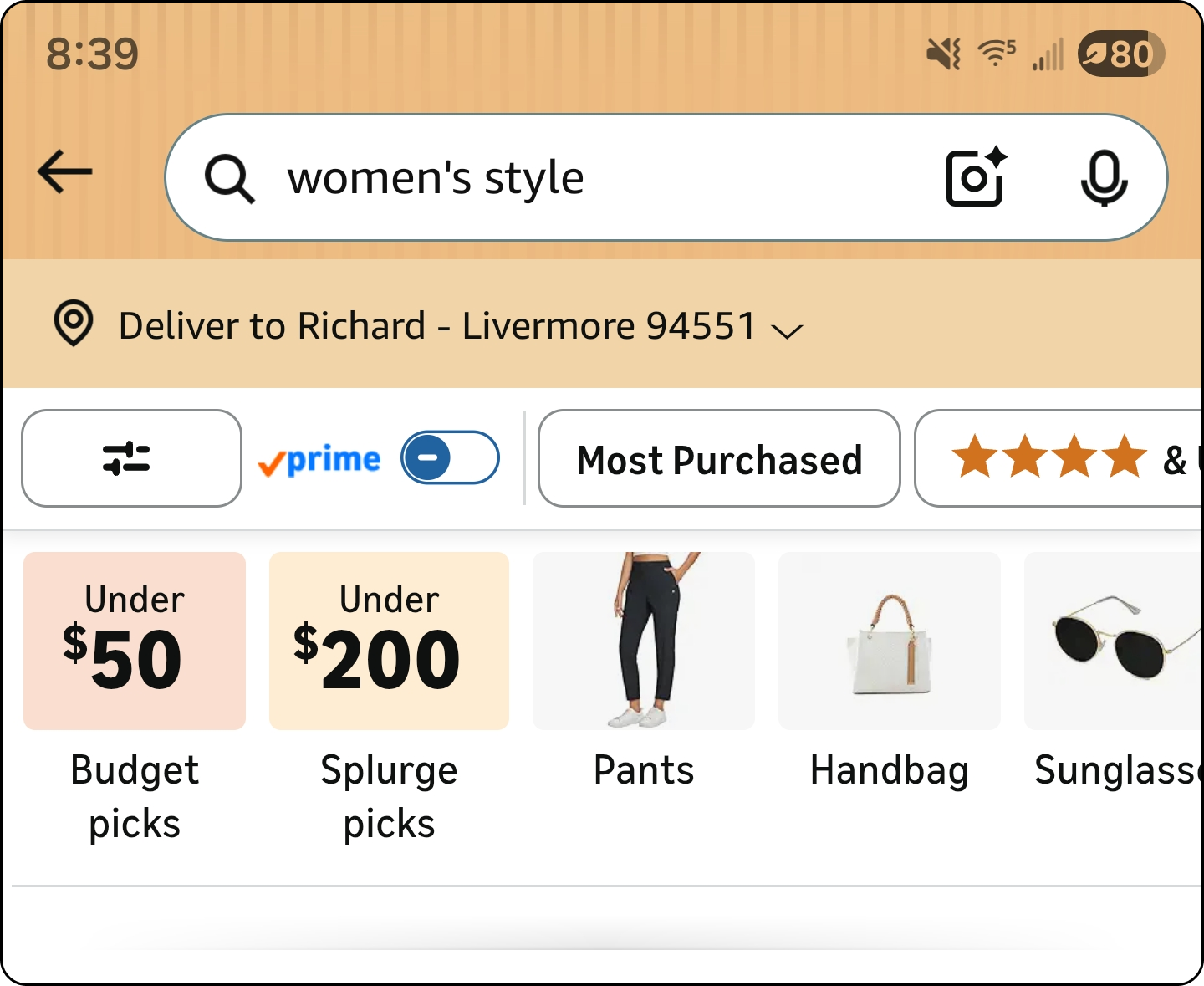
Amazon Deals introduced price based categories such as “Budget Picks” and “Splurge Picks” to help customers quickly understand and filter results by price point.